✨ Hidden Gems of Khiva
🌍 KHIVA, UZBEKISTAN · SILK ROAD
✨ Hidden Gems of Khiva
Beyond the postcards and tour groups — the quiet corners, forgotten courtyards, and living secrets of Itchan Kala.
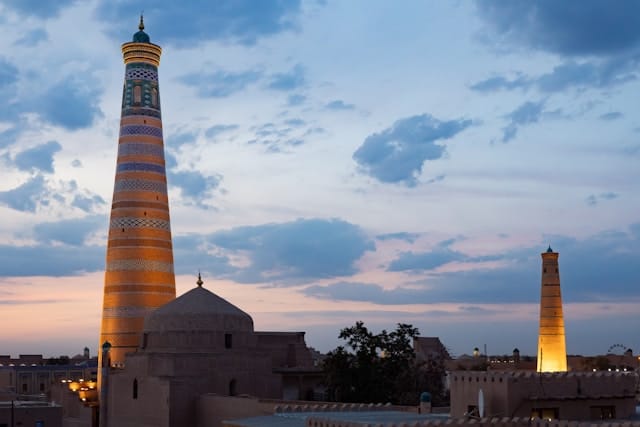
Everyone knows Khiva. The turquoise tiling of Kalta Minor, the sweeping views from Islam Khoja Minaret, the golden light on Pakhlavan Mahmoud’s dome. But Khiva rewards those who linger — who step off the main tourist path and into the labyrinth of mud-brick alleys where the old city still breathes. This guide is for them.
🏛️ 01 — ARCHITECTURE · RARELY VISITED
Tash-Hauli Palace’s Inner Harem Courtyard
Tash-Hauli Palace appears on every itinerary — but almost no visitor ventures beyond the ceremonial halls. Hidden deeper inside, the private harem courtyard is a masterpiece of intimate scale. Three levels of finely carved wooden columns, intricate indigo-and-white tilework, and a stillness absent from the grand facades define this space. The acoustics are remarkable: a whisper along one wall carries across the courtyard.
Built by Allah-Kuli Khan in the 1830s, the palace took eleven years and the labor of thousands. Yet this inner sanctum was seen by almost no one outside the royal household. Today it remains largely overlooked while visitors focus on the outer portal.
🔑 Insider tip: Enter from the eastern gate and ask specifically for the harem section (haramlik). It is included in the main ticket — most visitors simply never ask.

🕌 02 — SACRED SITE · DAWN VISIT
The Necropolis of Pakhlavan Mahmoud — At Dawn
The mausoleum of Pakhlavan Mahmoud — poet, wrestler, philosopher, and patron saint of Khiva — is one of Uzbekistan’s most sacred sites. But the building itself is only part of the story. The vast necropolis surrounding it, where generations of Khivan rulers and scholars are buried, is often overlooked.
Arrive at first light, before the crowds. The tilework reflects the early sun in tones of amber and cerulean. Local families come quietly to pray. The scent of fresh bread drifts over the walls from a nearby bakery. For a brief moment, the 19th century feels close.
🔑 Insider tip: The main hall opens around 8:00 AM, but the outer grounds are accessible earlier. Bring nothing — just remain quiet and respectful.
✨ Quote
“In Khiva, the most extraordinary things are not behind velvet ropes. They are behind ordinary wooden doors on ordinary mud-brick streets.”

🌫️ 03 — ARCHITECTURE · SENSORY EXPERIENCE
Juma Mosque and Its Forest of 218 Columns
Juma Mosque is visited — but rarely experienced. Step inside and allow your eyes to adjust. The prayer hall is supported by 218 carved wooden columns, representing over a thousand years of craftsmanship. Some were salvaged from earlier structures. No two capitals are identical.
Light filters through small openings above, forming soft beams between the columns. The atmosphere resembles a primordial forest — a sacred grove shaped in wood. Most visitors pass through in minutes. Stay longer.
🔑 Insider tip: Locate the third column from the north entrance — it bears an inscription dating to the 10th century, the oldest element in the mosque.
🧵 04 — LIVING CULTURE · CRAFT
Silk-Weaving Workshops of the Old Quarter
Beyond the main bazaar, in narrow streets south of Kuhna Ark, a few families still operate traditional silk looms. The rhythmic clatter of weaving echoes like the heartbeat of Khiva.
This is ikat silk — dyed in patterns before weaving, so the design emerges gradually from the loom. The craft has been passed down through generations. You can purchase directly from the workshop at significantly lower prices than nearby tourist stalls.
🔑 Insider tip: Visit between 9:00 AM and 1:00 PM when weaving is active. Show genuine curiosity — it is more appreciated than bargaining.

🌅 05 — LANDSCAPE · SUNSET
Western Ramparts at Sunset — Ata Darvoza Gate
Most visitors watch the sunset from Islam Khoja Minaret — beautiful, but crowded. Instead, head to the western walls near Ata Darvoza, one of the oldest gates of Itchan Kala.
The ramparts here are less restored and far quieter. Climb the slope and face west. The Kyzylkum Desert glows in copper tones at dusk, while the silhouette of Khiva rises behind you. The air carries woodsmoke and distant sounds of daily life.
🔑 Insider tip: Arrive 45 minutes before sunset. The most striking colors appear after the sun has set.
🍵 06 — CULINARY · LOCAL LIFE
Breakfast at a Neighborhood Chaikhana
Tourist restaurants offer good food. Local chaikhanas offer life. Early in the morning, residents gather for tea, conversation, and routine.
Breakfast is simple: fresh non bread from a clay oven, creamy suzma, and hot tea. The cost is minimal — the experience is not.
🔑 Insider tip: Ask your guesthouse host to recommend a local chaikhana. These places are rarely signposted.
📜 07 — HISTORY · OVERLOOKED SITE
Nurullah Bai Palace — The Forgotten Residence
Just beyond the eastern walls of Itchan Kala stands Nurullah Bai Palace, in a state of atmospheric semi-ruin. Built in the early 20th century, it blends traditional Khorezmian design with European neoclassical elements.
Few visitors reach it, but its painted ceilings, ornate plasterwork, and quiet gardens create one of the most evocative spaces in Khiva.
🔑 Insider tip: Exit through the eastern gate and walk about 400 meters south.

🧭 BEFORE YOU GO
🗓️ Best Time to Visit
April–June and September–October. Summers are extremely hot (45°C+). Winters are quiet but cold.
🏨 Where to Stay
Stay inside Itchan Kala for the full experience.
🎟️ Entry Tickets
A combined ticket covers most sites.
🚶 Getting Around
The city is fully walkable.
📷 Photography
Ask permission before photographing people.
🤝 Respect & Etiquette
Khiva is a living city — treat it with care.
✨ Final Thought
Khiva does not need discovery — it needs attention.