🥙 Must-Try Uzbek Dishes for First-Time Visitors
🌍 UZBEKISTAN · FOOD & CULTURE 🍽️
Must-Try Uzbek Dishes for First-Time Visitors
A first-time visitor's guide to the flavours, traditions, and tables of one of Central Asia's greatest food cultures.
Uzbek cuisine is not a side note to the Silk Road — it is one of its greatest legacies. For centuries, the crossroads of Samarkand, Bukhara, and Tashkent brought together Persian spice merchants, Chinese traders, Mongol nomads, and Arab scholars. Every culture left something behind at the table. What emerged is a cuisine of extraordinary depth: generous, aromatic, unhurried, and deeply communal. If you are eating here for the first time, this is where to begin. ✨
🍚 01 — THE NATIONAL DISH
Plov 👑
There is no dish more central to Uzbek life than plov. At its simplest it is rice, lamb, carrots, and onion — cooked together in a large cast-iron kazan over open flame until the rice absorbs every drop of fat and flavour. In practice, it is an art form with regional variations across every city and cook.
Tashkent plov is rich and dark, heavy with lamb fat and sometimes topped with quail eggs. Samarkand plov is lighter, the rice steamed in layers rather than fried. Fergana plov — widely considered the gold standard — uses a specific short-grain rice called devzira, red from the mineral-rich soil it grows in, with a nutty depth no other rice can replicate.
Plov is eaten communally, often from a shared plate. It is served at weddings, funerals, celebrations, and ordinary Tuesday mornings. To eat plov with an Uzbek family is to be briefly admitted into something sacred. 🤝
⏰ Insider tip: The best plov is eaten before noon. Plov masters (oshpaz) cook a single enormous batch at dawn — once it is gone, it is gone. Arrive at a plov centre by 10am.


🥟 02 — STREET FOOD · ESSENTIAL
Samsa 🔥
Samsa are baked pastries filled with minced lamb, onion, and fat — sealed into a triangular or round shape and cooked directly on the inner wall of a clay tandir oven. They emerge blistered on the outside, flaky and steaming within, with a pool of savoury juice at the centre that will burn your tongue if you are not careful.
You will smell a samsa bakery before you see it — the scent of lamb fat and wood smoke carries half a street away 👃. They cost almost nothing. They are sold from small windows at dawn, noon, and again in the late afternoon. There is no better breakfast in Central Asia. 🌅
Variations exist: pumpkin samsa in autumn 🎃, potato samsa for budget travellers, cheese samsa in certain regions. All are worth trying. The lamb version remains the standard by which all others are judged.
💡 Insider tip: A good samsa should be heavy for its size. Lift it before you buy — if it feels light, the filling has been skimped on. The best ones leave a grease spot on the paper they are wrapped in.


🍲 03 — SOUP · WINTER ESSENTIAL
Shurpa ❄️➡️🔥
Shurpa is the foundational soup of Uzbek cooking — a slow-cooked broth of lamb on the bone, large chunks of potato, carrot, onion, tomato, and bell pepper, seasoned simply with cumin and black pepper. It is not a refined dish. It is not meant to be. It is sustenance of the most honest kind.
The broth is everything. It is cooked for hours until it turns a deep amber, rich with collagen from the bones, and carries a warmth that feels medicinal 🌿. In the cold months — and Uzbekistan's winters are genuinely cold — a bowl of shurpa is what you order before anything else.
Some versions add chickpeas or fresh herbs. Either way, tear your non bread into the broth and eat slowly. 🍞
⏳ Insider tip: Shurpa is always better on the second day. If a restaurant has been open since morning, their shurpa will have been simmering for hours — order it in the afternoon rather than at opening time.
🔥 04 — GRILLED MEAT · EVERYWHERE
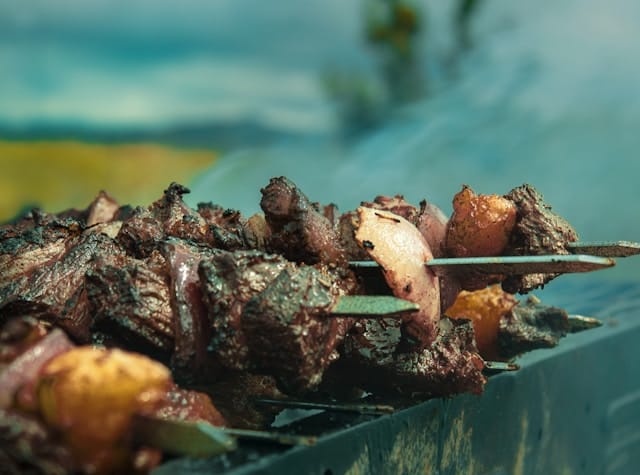
Shashlik 🥩
Shashlik — skewered meat grilled over charcoal — is the universal street food of Central Asia, and Uzbekistan does it as well as anywhere in the world. Lamb is the standard: cubes of shoulder fat-marbled and seasoned with nothing more than salt, black pepper, and cumin, grilled until charred at the edges and pink at the centre.
The ritual matters as much as the food 🎭. Shashlik is eaten standing up, or perched on a stool beside the brazier. The cook fans the coals with a flat board, sending sparks into the evening air ✨. You eat straight off the skewer, with raw onion and vinegar on the side and a flatbread to catch the drippings.
Liver shashlik (jigar) is worth trying for the adventurous 💪 — marinated in milk, it is far more delicate than it sounds.
🚶 Insider tip: The best shashlik is cooked to order from fresh meat. If the grill is already stacked with pre-cooked skewers sitting under a lamp, walk to the next stall.


🥟 05 — DUMPLINGS · SOUL FOOD
Manti 💛
Manti are large steamed dumplings filled with minced lamb and onion, sometimes with a little pumpkin added for sweetness, pleated closed in a distinctive pattern and cooked in a multi-tiered steamer. They are soft, yielding, and intensely savoury — eaten with a dollop of suzma (strained sour yogurt) and a drizzle of chilli oil 🌶️.
Unlike the smaller dumplings of Chinese or Georgian tradition, manti are substantial — three or four make a full meal. Eating one neatly is impossible and not the point 😄.
Manti are home food as much as restaurant food. The best versions you will eat in Uzbekistan will almost certainly be made by someone's grandmother 👵 in a kitchen you were not supposed to enter, using a recipe committed entirely to memory.
👀 Insider tip: In restaurants, ask if they are fresh (yangi). Freshly steamed manti have a translucent, slightly shiny skin — old ones look dull and feel heavy.
💬 "Food in Uzbekistan is not background — it is the whole occasion. A meal is not over when the plates are cleared. It is over when the tea is finished and the conversation has run its course." 🍵
🫓 06 — BREAD · SACRED STAPLE
Non (Flatbread) 🙏
Non is not a side dish. In Uzbek culture, bread is semi-sacred — it is never placed face-down, never thrown away, never wasted ❤️. Every region, every city, every family has its own version. Samarkand non is large and dense. Fergana non is thinner and crispier. Tashkent non is soft and pillowy.
All of it is baked in a tandir — a clay oven fired from within 🔥 — and eaten the day it is made. Fresh non tears apart in your hands with a soft resistance, releasing steam and a faint sweetness. There is no adequate substitute.
Non accompanies everything. It is breakfast with tea ☕. It is the vessel for shashlik drippings. It is what you tear into shurpa. To refuse bread when it is offered is considered mildly rude. Accept it. Eat it. Be grateful 🙌.
⭐ Insider tip: If you visit a bakery and watch the non being slapped onto the inner oven wall, the baker will almost always hand you a piece straight from the fire. It is the best thing you will eat in Uzbekistan.

🍜 07 — NOODLES · HEARTY
Lagman 🌶️
Lagman is hand-pulled noodles served in a spiced broth or as a dry stir-fry, topped with lamb, tomatoes, peppers, onion, and a blend of spices that varies by family and region. It arrived in Uzbekistan along the Silk Road from western China 🇨🇳, and it has been Uzbekified so thoroughly that it now feels entirely native.
The noodles are made by hand — stretched and folded repeatedly until thin and elastic — and are the defining element of the dish 👐. When they are good, they have a slight chew and a slippery resilience. When they are excellent, you will try to order a second bowl and probably succeed 😋.
Lagman has two main forms: soup (suv lagman) and the drier, saucier version (qovurma lagman) 🍳. The dry version is the more interesting — the noodles char slightly in the wok and absorb the lamb fat and spice in a way the soup version cannot achieve.
🔍 Insider tip: Judge the restaurant by whether they pull their own noodles — pre-made noodles are an immediate downgrade.
🍯 08 — SWEET · DESSERT
Halva and Dried Fruits from the Bazaar 🛍️
Uzbek dessert culture centres on the bazaar rather than the restaurant 🏪. The sweet shops of Chorsu in Tashkent, Siyob in Samarkand, or the bazaars of Bukhara offer an education in sugar and nut work that no restaurant menu can replicate.
Halva comes in dozens of varieties — sesame, walnut 🌰, pistachio, almond — each pressed into slabs and sold by weight. It is dense, crumbly, and not overly sweet. Alongside it: dried mulberries, apricots 🍑, figs, and the extraordinary sweet dried melon strips that taste like concentrated summer ☀️.
Nuts are equally important 🥜 — walnuts, pistachios, almonds, and pine nuts sold fresh from the shell, sometimes coated in sugar or spice.
😊 Insider tip: Taste before you buy — every stall vendor expects it and will offer without being asked. The best halva will leave a clean, nutty finish with no greasiness.
📋 EATING WELL IN UZBEKISTAN — PRACTICAL NOTES
⏰ When to Eat — Lunch is the main meal of the day, typically between noon and 2pm. This is when plov centres are open, kitchens are at full production, and the food is at its best. Do not save your appetite for dinner.
📍 Where to Eat — Chaikhanas (traditional teahouses) and plov centres consistently outperform tourist-facing restaurants for quality and authenticity.
🥦 Vegetarian Visitors — Uzbek cuisine is meat-heavy, but not impossible to navigate without it. Pumpkin samsa, vegetable lagman, fresh salads, non bread, and the extraordinary bazaar sweets and nuts will carry you well.
🍵 Tea Culture — Green tea (ko'k choy) is served with every meal, always without milk, always in a small bowl (piyola). It is refilled constantly. Accepting it is the beginning of every real conversation.
🤲 Sharing — Uzbek food is designed to be shared. Order generously, eat communally, and leave nothing in the dish — an empty plate is the highest compliment a cook can receive ✅.
🐢 Pace — A proper Uzbek meal cannot be rushed. Budget two hours for lunch in a good restaurant. The conversation is part of the meal 💬. There is no higher recommendation for a table than that no one wanted to leave it.
✨ The best meal you will have in Uzbekistan will not be in a restaurant. It will be in someone's home, at a table you were not expecting to sit at, eating food you cannot quite name — and you will understand every word of it. 🏠❤️